Showing posts with label art. Show all posts

Sunday, April 21, 2019

Salmon Fly Finale 2019

My Salmon Fly season 2018-2019 ended - well, two months ago😢 I've been posting on social media as each fly and each fly has been completed. So this is the summary and wrap-up post for those who don't use social media and who missed it.

From Frederic Tolfrey's "Jones's Guide to Norway",
The Colonel
 and The Major

 And I framed as

SALUTE Frame done by Admiral Yamamoto

As I've been doing this for the past several years, I've been acquiring and accumulating some of expensive materials one by one. This past season, when I stopped momentarily and looked around, I found out that I have enough materials to challenge some of Major Traherne's patterns. And I really like this step and process that I've been through and accumulated. Meanwhile, my skills and interpretation have gained significantly. I was finally qualified to challenge some of the most complicated patterns among all classics without wasting expensive and exotic feathers.

Gitana
I call this "White Frame" as in The Beatles' "White Album". It needs no explanation as it speaks it self.
I listed materials as per the most reliable source, along with honestly stating substitute materials.

Nelly Bly - this is my own favorite😲👏


Quinchat
Its body is equally complicated and challenging as Nelly Bly above.


 So here they are.
As much as this past season was satisfying, I'm already preparing and looking forward to the next season😃Oh well, fishing and guide season has started before that😏 that will be a next post❗❗

Thursday, January 31, 2019

Salmon Flies 2019

We have had a few snow storms but over all this winter has still been average = just cold and snow accumulation at our headwaters are just around average.

I've been primarily busy with my salmon fly projects. Here's one that has been going on since the end of last year.

I designed this😎 Although I don't mean to totally replace the previous colorful one, I just needed one that's much simpler and totally original.
And that's for a totally original item❗❗❗
My own outfitting logo hat has just been created👏👏👏❗❗❗❗
 As you can definitely tell from this picture, it sports a 4-inch long bill, that should offer me perfect shade while fishing!!

Inside is special too. It's lined with comfortable and cool & stain-minimizing mesh😁
Now my logo is a silhouette of a salmon fly😲
And the belt & buckle will adjust exactly for one's and each head😇

I'm sincerely glad that I did lots of researches and pondering.
I could have asked someone to design a logo but I really wanted to do on my own. Then, once the logo was made, there are so many styles of hats available, including much less expensive ones. But I wanted a hat that can be one of our important and essential gears while fly-fishing. The long bill style here is not just a distinctive appearance but also it does give us some more extra shade than regular hats😎.

Luckily I have a professional model right here😊


Now here are actual salmon flies😲 that I dressed since the last post.
Rocke's Fancy (G.M. Kelson)

Stevenson (G.M. Kelson)

Gitana (Major Traherne)
This is another elaborated Tarherne patterns😫 with so many feathers. But it's very rewarding when it was successfully wrapped up with a neat head😬

I have a few more patterns to dress and frame this season. In other words, I have to see the end of my salmon fly season😥😭

Saturday, December 29, 2018

'Tis The Season

Merry Christmas & Happy New Year🎄🎅🎉🎊
I have sent out a newsletter from my main website. If you have not joined, sign up or you let me know so you don't miss any future news and announcements from me😉

Also this is the season to be deeply engaged with Atlantic salmon flies and arts. Nowadays these tend to be published on social media = Instagram & Facebook = so if you haven't registered or found me yet, please do so and you'll get the latest updates ASAP😉

Also #2, I just conducted some major changes on my website. You know my other blog = fly catalog site. I moved all of my Atlantic Salmon Fly contents to my main website. I made a short update on my catalog site. Then if you go to my main website, you'll see all the improvements❗❗ 

As I have been doing for the past few years, I submitted my works to Livingston Center for Art & Culture. Items for this exhibition have grown to be an opportunity for me to show slightly unconventional, compared to traditional Atlantic salmon flies and framing methods. This time, both flies and framing methods are free-style and I decided to "go country"😲

Queen of Silver Dollar - an inspirational & interpretive dressing of the song by Emmylou Harris.


The Man in Black - an inspirational & interpretive dressing for Johnny Cash.


For both flies, I attached a laminated "artist note" about the concept. Feel free to ask!

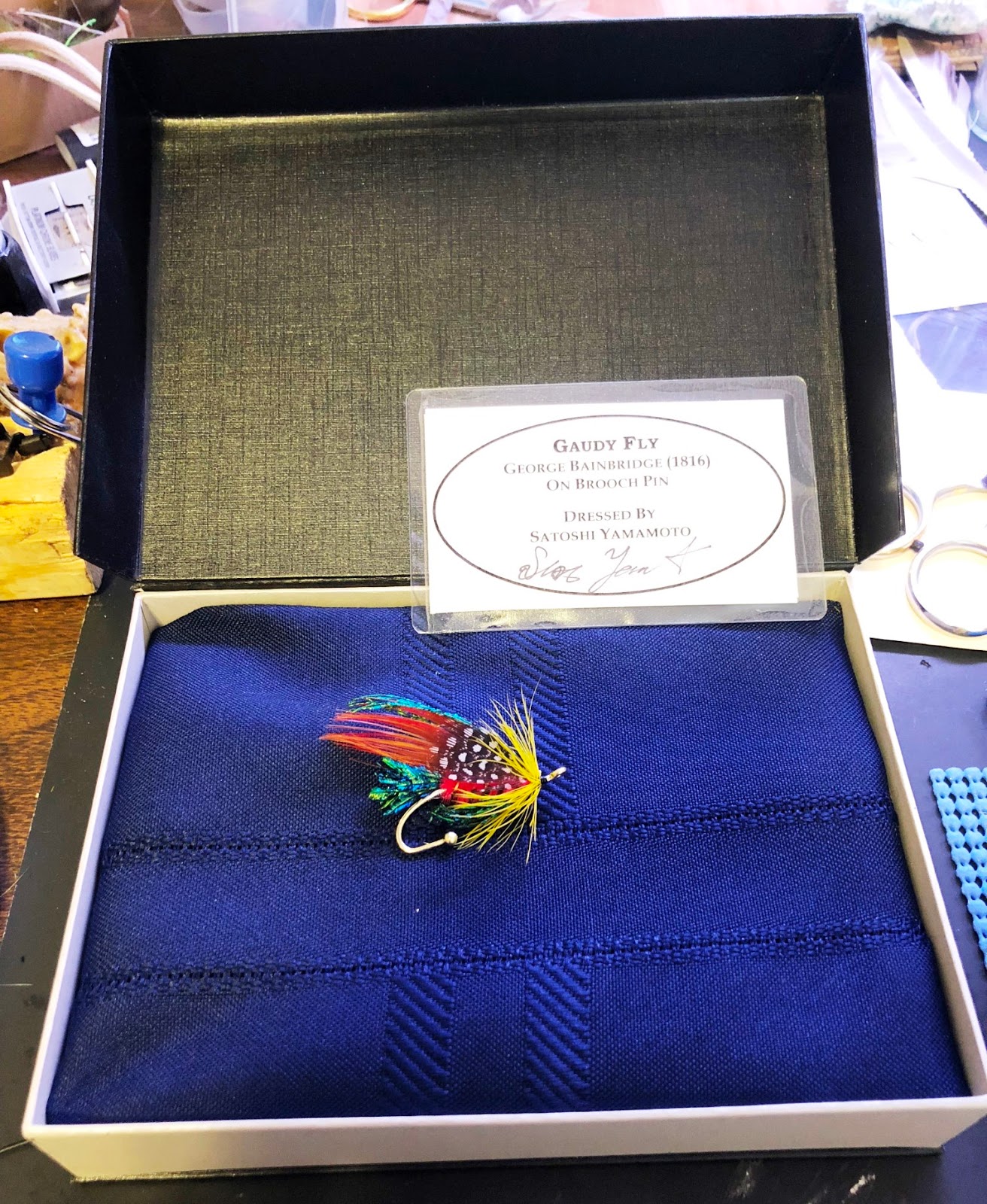
Gaudy Fly - tied on a gold broach pin. Pattern itself is a very classic but dressing on a broach pin was the very first attempt😳. I tried to dress as Gaudy as I could, and managed the features of the pin💪👏

Presented in a showcase style box❗


Then I resumed my winter project. I completed George M. Kelson's "The Salmon Fly" Plate 4.
Here's a Bluebell (Traherne's)

Also Traherne's is The Chatterer


 This is one elaborated fly ever😲🙌👏


The Dandy. This is rather a simple whole-feather pattern yet very graceful. This is perhaps the smallest head I ever achieved👏


And here's the frame😬

I'm glad to get one done with a good note just at the year end😁❗
I'll keep working on GMK flies but no rush. I may work on one or two flies of Plate 5 but then I also have several more patterns I want to work on. So let's keep the artist mode running till spring😀

Till next post👋
I hope you all have a good year end and start😉

Thursday, October 25, 2018

So Long..............

It's been Soooooooooo long..................  I have not forgotten this blog of mine or never meant to be lazy.............. For some reasons, my life hadn't been running as it was supposed to be for the past couple of weeks. Nothing serious or deleterious, such as accidents or sickness, it was just "off the rail"😞😩

I tried to remain productive. I started to use Firehole Sticks, produced right here in Bozeman, MT. These are some of very unique sets of hook styles that fit in my needs and patterns. I immediately like this one for my small dun/emerger patterns for spring creeks = curved & short with extra wide gap😆

On top of books I had bought but couldn't read through during the last winter and this spring, I just bought many more books📕📖📚👀
As you can see, I've been into history of fly-fishing and fly-tying. I buy from a couple of online stores within US. Also this time, I ordered from Medlar Press in England. Besides reading and learning history, I want to improve myself as a casting instructor with Jason Borger's new casting book.

Sage Skues is reading with me too 😉 This is Captain Hale's "How to Tie Salmon Flies".

I have just got back on track...........somewhat😑
Hopefully the next post won't be in such a long gap and be more colorful✌

Thursday, February 8, 2018

The Wilson

This is the first ever blog post totally & only dedicated to the Atlantic salmon fly. I'd just like to share my struggle with one particular pattern. By doing so, it would explain the insight of what's going on in a dresser's mind and perhaps how & why one can be captivated by and pursue this subject for the rest of his life.

As I've been posting for the past couple years, I've been working on George M. Kelson's illustrated plates as in his own mighty The Salmon Fly. Plate 1 was completed in November 2015. Completed Plate 2 frame and 6 flies inside were shown in two posts before. Plate 3 has also been completed. I have not posted on this blog but it's already shown at my fly catalog, then in other media such as Facebook and Instagram.

Plate 3 contains patterns with their own quirks. I'd say Durham Ranger and Benchill would be straight-forward and familiar in general way. Then rest of 4 patterns require technicality and interpretation. Uhhhh.........now I really want to go over all the patterns!!
...........To me, The Wilson, which is seemingly a simple pattern, offered me quite a challenge. Why & how? Let me go over from the recipe.

Tag.   Silver Twist and cream silk.
Tail.   Two strips of Summer Duck.
Butt.   Black herl.
Body.  Silver tinsel.
Ribs.   Gold tinsel (oval).
Throat.  Vulturine Guinea fowl and black Heron.
Wings.  Egyptian Goose, little Bustard (cream feather), silver speckled Turkey, grey Mallard, and a topping.
Cheeks.  Indian Crow and Chatter.

It's very much straight-forward at the beginning. The first challenge may be a heron feather for throat. Heron feather is hard to obtain and own in US so most of the time modern dressers use a sort of alternative. In my case, it's not always perfect or look-alike, I dyed and used a turkey marabou (oftentimes used as an Eagle substitute, which also hard to obtain and own in US). Looking back these pictures, I like my choice and what I did.

Then came next the hugest challenge to interpret: wing and materials...........
I have light-colored Bustard and speckled turkey, both of which are easy to incorporate in married wings. Egyptian Goose feathers seem obtainable (Google it!) but which part? In Essential Kelson, Marvin Nolte annotates: "Kelson offers no advice as to which feather from an Egyptian Goose is preferred. The wings and tail of this bird are not especially striking, while the barred body feathers definitely are. Whole flank feathers as an under-wing are possibility". The illustration "might" indicate so too.............OK...............as for the feather, Egyptian Goose flank feather is very similar to Pintail, Teal, or Gadwall, which I have plenty. I decided to use a pair of Pintail as whole-feather (actually slightly modified to fit under the married wing). For grey Mallard, I can use Mallard flank that we often use trout streamers or as tail fibers of nymphs.

So I set the modified pair of Pintail (some struggles here but I made it). Then I was going to marry rest of feathers. I applied "Rule of 24" as I always do: try to keep the number of barbs of married wings at 24 (of course some exceptions apply). I got ready 8 barbs of Turkey and Bustard. For the duck feathers, rather than actual number of barbs, I cut out a strip in the same width with the stem (rachis) attached.  Then here's when a big HOWEVER happened. Mallard flank doesn't show well on & against the Pintail under-wing (or, I'm sure, even when Egyptian Goose is actually used) UNLESS the strip is married above Turkey and Bustard. However, there is no such long barbs. I didn't consider marrying in and among Turkey and Bustard as marrying and mounting would be nearly impossible. So, I decided to substitute grey mallard with Bronze Mallard, which is much darker and shows well over Pintail. So I cut out the Bronze Mallard in about 8 barbs width and married with the others. Any married wings incorporating any duck feathers are very challenging to keep them married and mount, but with experience, it can be done.
I completed the rest and here it is.


I think it was OK and acceptable. However I somehow had this nagging feeling. I could have done better............sorta. Couldn't I use grey Mallard? Also it may not be able to spot or tell in the picture but Throat-Wing-Head transition wasn't smooth............Also the topping is not quite my liking (sticking up........)
After I completed Durham Ranger, the last one of 6, I decided to rework on The Wilson. I carefully peeled off head coating, found the thread, then started unwrapping one at a time. I undid the wings and I even had to redo throat as well. I used a pair of Pintail again, this time slightly longer than before. Then this time, I decide to use grey Mallard as Roof😏 Why not? Roof is a part of the wing and sometimes it's not clearly mentioned in the recipe (in classic literature, when it's specified, it's said "cap" or "capped by Bronze Mallard"). I knew I can do this! So I assembled 12 barbs of each Turkey and Bustard = total 24 barbs and married in kind. Mounting was much easier. Then I set a matched strip of grey Mallard as Roof = set above and along the curve of main wing. Rest of materials were attached. I was satisfied with the topping this time and so with the head👏😉


So this is how I interpreted and completed The Wilson.
Reading this through, some of readers may wonder why I mention interpretation so often. Or why just tying flies requires interpretation. Atlantic salmon flies we know now are based on written literature. Not many flies or not every pattern exist for us to see and examine. Of course there are some set rules to complete these complicated flies. It's not the result of something at random. So, in terms of art, it's not a random junk art with one's own radical ideas. Techniques and disciplines can be learned only through practices after practices. However there is NO set rules for certain aspects or even mentioned/explained in literature. For example, in married wings, there is no clear or set rule for which color/feather goes above or below. Certainly, did our ancestors make such complicated married designs? Furthermore, why the same pattern is varied by each author and is with different materials (plus or minus) and style?

In modern days, when we say or think about one fly (trout, steelhead, modern Atlantic salmon, whatever), majority of fly anglers and tyers have one common image of that pattern, tied in the same color, with same materials. Although I can't inspect each pattern's history and origin and state here, those patterns have been exposed to and among more people and more media (books, magazine, eventually internet) than Atlantic salmon flies. Atlantic salmon flies have such a brief history and only a very short period = late 19th to early 20th century = is known to be the Colorful Era or the Golden Age. They were primarily tied, used, and published in and among British Isles, furthermore, only among salmon fly-fishers of which numbers must have been much less than now. Though this is just our speculation, either Jock Scott, Green Highlander, Doctors, etc............one author and/or his friends/correspondences might have written up their own variation...............

Speaking of speculation, when we deal with this kind of "near lost" subject, we tend to speculate some to lots. Back in days, have they really made such colorful and elaborated married wings like we do for framing purpose? I doubt it........... This is apparently our own methods in modern days, and each dresser does differently and uniquely. The list of this kind of questions goes on.......... Have they used a strip of Wood Duck or a tip of entire feather? Have they married Parrot and Ibis feathers for wings? Were there such long barbs? How big were flies actually? Etc., etc., etc.,..............

Only by keeping working on and practicing salmon flies, one will encounter these aspects and questions. Then only by keeping doing so, one can come up with interpretation - I don't use "answers" as there may not be!! Of course by then he must be developing some confidence in his technique and products. Someone who have lots of experience can teach and explain. I might have pestered my mentor at this transitional period. I can't thank him enough.

On top of these, we in modern days are doing this as and calling "art". Now the subject and discussion become more complicated!!

However there are a few things I'm sure of. First I'm sure these are not derived from my ego or not because I'm full of myself. I believe there are some set rules (techniques and theories) that are common and need to be learned to complete Atlantic salmon flies. On top of these fundamentals, NOT "under" as it sounds limited, one can develop his/her favorites and styles. Then once one develops into such stage, recognize and accept other people's. Good or bad? Pretty or ugly?  Rather than criticizing and hurting each other among fly-tyers, critique your own flies first! Then I think it may be better to show people who don't tie and their opinions and views!!

By working on and completing The Wilson, these thoughts and memories kept flushing in my head so I had to write up.

My personal journey goes on.............. one fly at a time............

Sunday, November 19, 2017

Winter & Tying Season

Immediately after the previous post, winter arrived abruptly yet just as we anticipated. Hence, I started to spend more inside at my tying bench with much more time and enthusiasm than ever! 

I try to upload tying videos on my YouTube channel once a week until spring. There might be a few absence due to holidays etc., but I don't think I would run out of patterns on the list!

Also, I often post these pictures on Instagram. I seldom handle my i-phone when I'm near and around waters for social media purposes............. It works well for me at my bench. And there are some superb tyers and enthusiasts out there too.

One project I was eager to work on was 6 flies of Plate 2 in The Salmon Fly (1895) by George M. Kelson. Within 2016, I finished 3 of them. Then rest of winter and spring were occupied with personal moves. So those 3 flies had been unframed and kept in small plastic containers for a year. Then the rest of 3 were finally completed😌. But also it was worth a wait. I came to know a professional framer in Livingston and he gave me ideas and tips. I asked him if he can make oval cutout mats. That makes my life much easier after dressing😄

So here they are.
In an alphabetical order,
The Baron


Harlequin

John Ferguson

The Lion

Silver Doctor

Thunder and Lightning


I also made a few single-fly frames.
The Wild Irishman - see the background photo of the frame😏


And..............
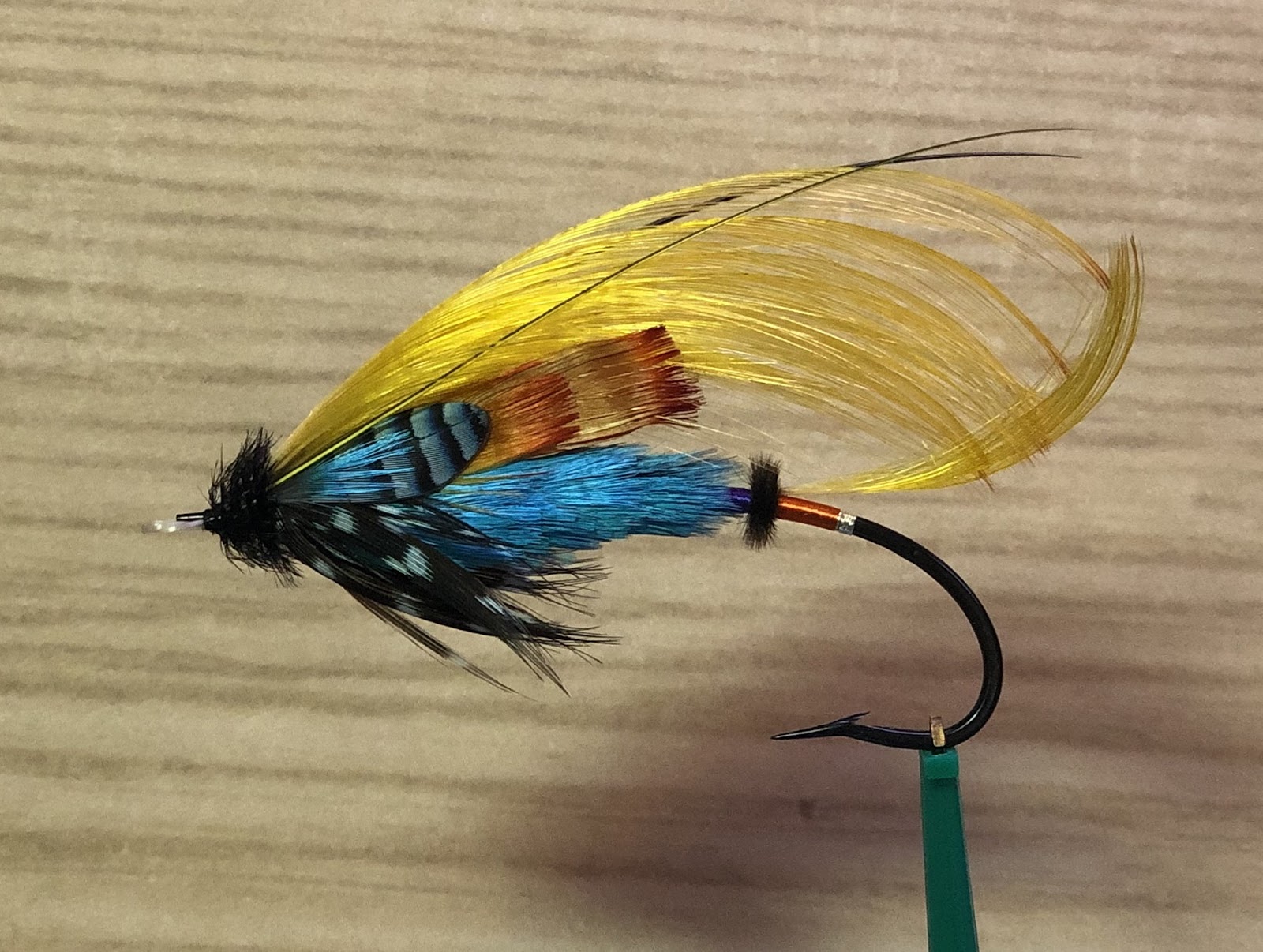
This is definitely the one of the most complicated and busiest patterns ever recorded with three tail veiling, two body hackles, two throat hackles, two cheeks, and the list of feathers for wings😓 However the result and accomplishment are very satisfying😙

Happy Turkey Day every one🐦🐔🍗😋

Thursday, January 12, 2017

The Salmon Fly

Happy New Year!! 
-------- Sorry for being late and absent.............. I've been busy, sometimes distracted, with many things...... Hope all of you have had a good start of new year. Gone any fishing?  - in that regard around here, nothing to miss around here.............COLD!! and lots of SNOW!! Though not much fishing is going on now around here, we strongly welcome the Return of Big Old Winter and are already anxious for good summer flows in area rivers!!! It's strongly advised to start thinking about your fishing trips to Montana and Yellowstone National Park for Greater 2017!!

++++++++++++++++++++++++++++++++++++++++++++++++++++++++++++++++++++++++
Before I go on, I'd like to introduce that my good friend & neighbor launched a website;
I know he goes to China every winter, then inspects and selects only top quality Tonkin Bamboos for Cane Rod Building. Every rod builder and enthusiast should check his website!!
++++++++++++++++++++++++++++++++++++++++++++++++++++++++++++++++++++++++

As I announced in the newsletter, I've been working on salmon flies, off and on, since last September (usually a few in October then full-time from November). Though I've been posting so often at Facebook, I don't think I've done here. So this post will be the comprehensive coverage!!

Following 5 flies were dressed for exhibition (and consignment) for Livingston Center for Art & Culture. Each was framed in a single shadowbox.

Dusty Miller (George Kelson): This is an unusual style as "toppings inside out" on each side.

Green Highlander: I have special feelings for this pattern. This was the first pattern I worked on with my teacher. How many did I practice............... I must have come far..............
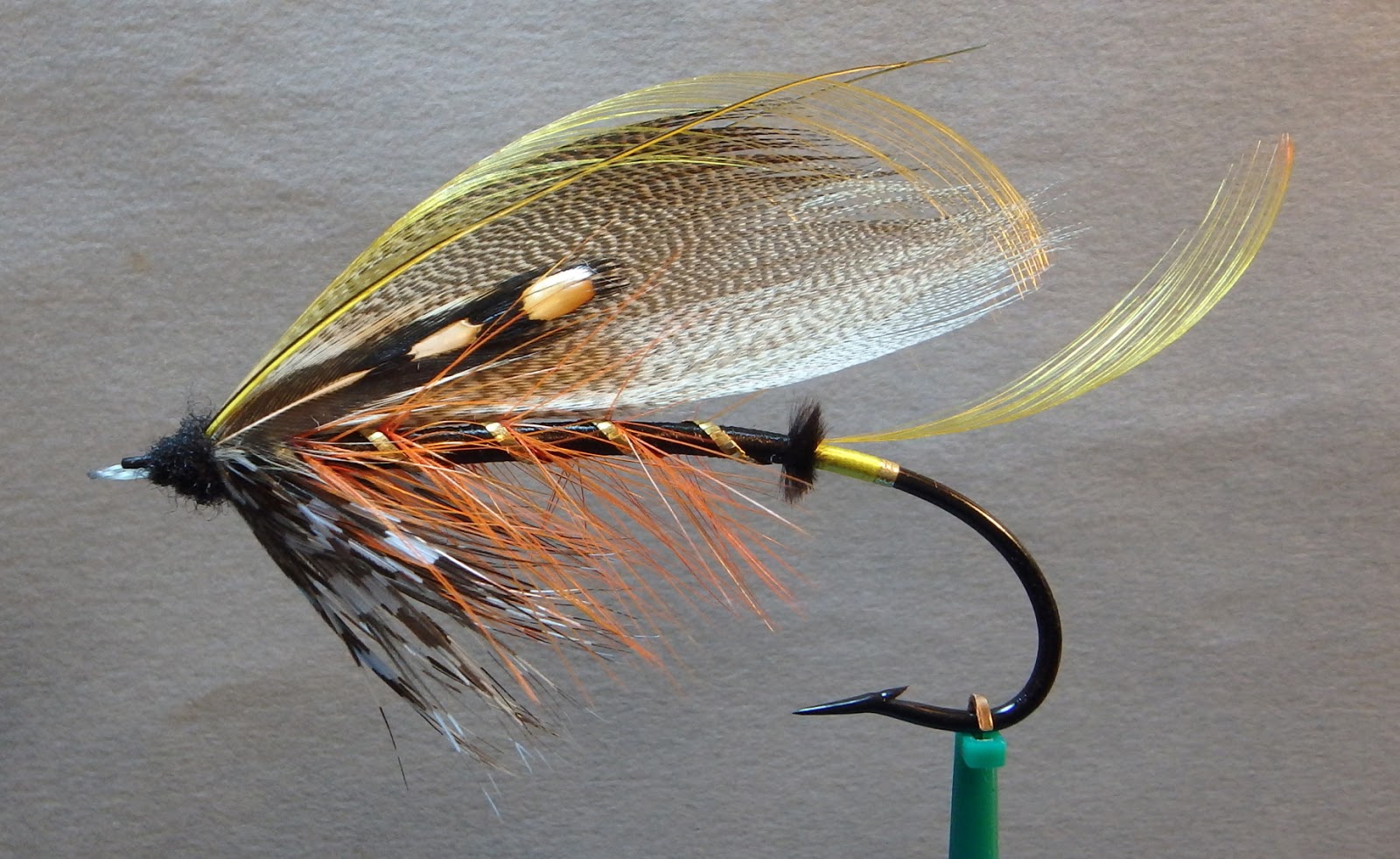
Evening Star (Major Traherne): None of Major's patterns come easy........ This is one of whole-feather patterns.

Following two are, in my opinion, very unique among Major Traherne's patterns as these are ONLY 2 patterns with married wings.  Furthermore, styles and proportions are practically the same.

Fra Diavolo: Amherst pheasant tails show quite accents!
Traherne's Wonder: Above said, actually some say this is not exactly a Major's pattern............ Anyways, this is my most favorite one. I'm happy with wing color schemes, then how Roof came out with Summer Duck (Barred Woof Duck) strips............
And they were all framed like this!! I received great reviews from Center and audience.

My own projects, that I assigned to myself, are going on as well.

This is actually the second time that I worked on Dr. T.E. Pryce-Tannatt Plates 3 & 4 in his "How to Dress Salmon Flies" (oh, how green I was back then😳). I'm very satisfied with how each fly came up and my presentations & framing in the groups.

Plate 3: These were dressed on Partridge of Redditch CS 10/3, 3/0, 2/0, 1/0, respectively.

Sir Richard: I decided to finish in this style though I do have each feathers, used in wings, with longer barbs that reach the tail.
 Benchill: I like it!
 Childers: I like this one too!

Plate 4:
Helmsdale Doctor; dressed on Harrison-Bartleet Dee 3/0 - it's a very long hook! This is another favorite of mine!!
 Gordon: dressed on Harrison-Bartleet 4/0, very colorful!!
Silver Doctor: dressed on Francis Francis 3/0. This is another initial pattern I worked with my mentor. Again, I must have come far..........

Then this is the ongoing project...........No date set for completion.........
You'll easily guess what I'm working on.........All of these are and will be dressed on CS 10/3 3/0 = 5/0 for most hooks.

Harlequin: Looking simple but it's not easy to come....... Another favorite from this season!
Silver Doctor: Compared to Pryce-Tannatt's recipe, GMK's consists of a few less materials. Either way another 🅰 Doctor from this season!
Thunder and Lightning: T & L is another one of those patterns that has so many variations by each era, author, and book. Following GMK's recipe, I finished with my style. Simple yet elegant, I like it!

Hopefully you are tying some flies for the upcoming season!!
And someday soon, when snow gets shorter for easy access and river waters have no ice jams, I hope to go fishing!